Abstract: Can A Kiss Save the World? The Chinese fantasy show Cang Lan Jue demonstrates a radical vision of love. Situating its imagery of the kiss alongside the Catholic mystical reception of the kiss in the Song of Songs, this essay presents the understanding that a kiss of two lovers can set the world aflame, giving birth to life and peace.
摘要:一吻能否救世?近期播出的仙俠劇「蒼蘭訣」繪製了一幅關於愛的絕佳願景。本文將劇中之吻與公教密契傳統對雅歌之吻的闡釋相結合,展示了情人之吻能點燃世界,孕育生命與和平的認識。
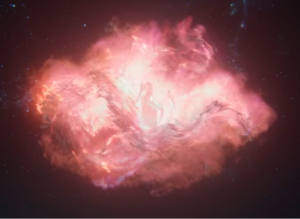 Figure 1″ The kiss between Xiao Lan Hua and Dong Fang Qing Cang awaking the “flame of heaven” (Screenshot from Cang Lang Jue, Episode 36)
What can a kiss do? The Chinese fantasy show Cang Lan Jue, recently aired on Netflix under the English title Love Between Fairy and Devil, demonstrates a radical vision. Cang Lan Jue is the second to the most popular television series in the history of iQiyi, the Chinese online video platform launched in 2010 and one of the largest online video sites in the world. Based on the novel authored by Jiu Lu Fei Xiang, the show revolves around the story of Xiao Lan Hua and Dong Fang Qing Cang. It begins with an accidental kiss that created a spell that bonded Dong Fang Qing Cang, the lord of the Moon Clan at Cangyanhai, with Xiao Lan Hua, a lowly celestial being at Shuiyuntian, so the former shares in all the affections of the latter. The story is situated in the backdrop of a historical war and the ongoing enmity between the two peoples. Thirty thousand years ago, the heavenly realm defeated the Moon Clan, sealing its 100,000 soldiers and imprisoning Dong Fang Qing Cang at Shuiyuntian. Xiao Lan Hua, who grew up in Shuiyuntian, is familiar with the story of the war that tells of the evilness of the Moon Clan, especially the devilishness of Dong Fang Qing Cang, and the righteousness of celestial beings. The accidental kiss freed Dong Fang Qing Cang from his imprisonment and is the first personal encounter of Xiao Lan Hua with Dong Fang Qing Cang. After his escape, Dong Fang Qing Cang’s plan to return to his people at Cangyanhai, release the 100,000 moon clan soldiers, and crusade against Shuiyuntian was delayed by the necessity to undo the spell. The undoing of the spell, the growing mutual affection of Dong Fang Qing Cang and Xiao Lan Hua, the increasing openness of Xiao Lan Hua to the humanity of the Moon Clan, the expression of her love for all living beings, and the discovery of Xiao Lan Hua’s true identity as Xi Yun – the goddess of life, constitute the main plot of the story. While Dong Fang Qing Cang must violently eradicate his seven affections to acquire immortality and the ancient power, “the fire of hell”, to wage war against Shuiyuntian 30,000 years ago; Xiao Lan Hua’s love not only restored Dong Fang Qing Cang’s affections, directing them all toward love, but accumulates in the awakening of “the flame of heaven” that brought life and peace to the world. The latter is also “the flame of mercy” – the even more ancient power – that can be yielded only by the pure in heart and those who are tempered by affections and passions. This transformation is actualized through another kiss, this time, fully intentional, expressing Xiao Lan Hua’s absolute free will to love in the face of evil. Yet, the realization of Xiao Lan Hua’s commitment is not without cost and is only achieved by sacrificing her own finite life as Xiao Lan Hua, through which she freed Dong Fang Qing Cang from the bondage of the spell, released the 100,000 Moon Clan soldiers, and restored life to casualties lost to war. By dying of love, Xiao Lan Hua resurrects and reclaims her true identity as Xi Yun, who is destined to extinguish all enmity and sustain all living beings. Love and peace constitute the central theme of the show. They are actualized by a kiss of two lovers.
The imagery of the “kiss” signifying both love and peace also features prominently in the Catholic mystical tradition. The Song of Songs opens with such a kiss, “Let him kiss me with the kisses of his mouth!” (1:2a) Throughout centuries, this kiss has drawn numerous exegetists, approaching the Song as the definitive expression of their amorous experiences. As the crowning achievement of the tropological reading of the Song and the superlative contribution of monastic theology to Christian spirituality, St. Bernard of Clairvaux’s eighty-six Sermons on the Song of Songs began with the investigation of the kiss. Already, St. Bernard had linked the kiss with peace, calling it “the token of peace.”[1] For St. Bernard, the Song is reserved for men of peaceful minds and those who can “achieve mastery over the turmoil of the passions and the distracting burden of daily chores.”[2] The kiss of the mouth is a sign of divine union in love. St. Bernard taught that the one who asks for a kiss, that is the bride, is a lover.[3] The bridal imagery of the Song embodies, in the highest degree of perfection, “that sweet interflow of affections between the Word and the soul.”[4] The kiss between the bridegroom and the bride denotes “the conjoining of natures [that bring] together the human and divine,” reconciling all things to God.[5] It is a person, the one mediator between God and humankind, who is Christ Jesus. He is peace and it is by the token of this peace, peace is secured.[6]
Rooted in the Song’s extensive interpretive tradition of Western Christianity throughout the Middle Ages and early modernity, St. Teresa of Ávila, as the first woman daring to write a commentary on the Song, read the kiss as “the sign of great peace and friendship among two persons.”[7] True peace, according to St. Teresa, is obtained through the union with God’s loving will.[8] The kiss is a lofty petition voiced by the soul. St. Teresa interpreted the words of the Song as if they were spoken directly by God to guide souls toward divine union. The language of the Song serves as a double utterance, describing both the love of God to the soul and the soul’s loving response to God.[9] The kiss becomes the gateway to holy peace and love, inviting the soul to enter deeper into union with God.
Similarly, St. Teresa’s close companion, St. John of the Cross, esteemed the kiss as “a substantial touch…wrought in…close intimacy”[10] with God. The exclamation “Let him kiss me with the kisses of his mouth!” is uttered by the soul at the seventh step out of ten on the mystical ladder of divine love, where the soul is characterized by an ardent boldness and love.[11] St. John’s explanation of the mystical ladder was located in his teaching on the dark night – a night that is also called as “secure,” “peaceful” and “tranquil.” The exclamation of the kiss is associated with the scripture reference of Moses beseeching God to forgive the people or else strike his name out of the book of life.[12] It is in this night, the soul receives in God a perfect peace, stemming from perfect love, which casts out all fear.[13] The kiss at the seventh step only leads to the ninth step where the perfect soul “[burns] gently in God.”[14] Here, the soul is inflamed in the divine union by the Holy Spirit who is the flame of love.[15] It is “so forcefully transformed in” and “so sublimely possessed by” God,[16] feeling the Spirit within itself “not only as a fire that has consumed and transformed it but as a fire that burns and flares within it…And that flame, every time it flares up, baths the soul in glory and refreshes it with the quality of divine life.”[17]
There are deep affinities between the Catholic mystical tradition and the cultural artifact of Cang Lan Jue, not least limited to the shared reference of the kiss, the theme of love and peace, the imagery of the flame, and the expression of ascetical ideals. Contemplated together, they mutually illumine a radical vision of love that divinizes the world by its participation in divine life, where peace is final. Deep within the Catholic consciousness, there remains an ambivalence towards the nature of love, guarding the boundary between the Creator and creation, distinguishing agape with eros, and sublimating the latter for the former, thus placing the divine over the human, the religious over the secular, the spiritual over the corporal, and celibacy over marriage. Though Vatican II has proclaimed the universal call to holiness, our understanding of human love has yet to reach the height of mystical theology. It is here that Cang Lan Jue’s vision proves to be bold. What Dong Fang Qing Cang’s denunciation of his affections alludes to is the extreme asceticism of the monastic ideal, prevalent in Buddhism, Daoism, and Christianity. To obtain peace for his people, Dong Fang Qing Cang was taught that he must forsake all his love and claim just war against Shuiyuntian. On the other hand, Xiao Lan Hua’s protest that “Why in loving all living beings must I forsake the person that I love? Why must I be forced to choose between the two? I refuse!” issues a powerful cry that resonated with many of its audience, making it the most famed line of the show. Xiao Lan Hua’s vision of love is unapologetically univocal. Her love for Dong Fang Qing Cang and all living things is one, as the word “Cang” in the title denotes both Dong Fang Qing Cang and the Chinese term “Cang Sheng”, which means all living things. Further, as the embodiment of love, Xiao Lan Hua, the name meaning little orchid, finds her true identity in Xi Yun, where the name Xi refers to breath and Yun refers again to all living things. That is, the breath of life, which is love, finds expression in a single plant. The show closes with Xiao Lan Hua’s pronouncement of the ultimate power of love, “the enmity and war between two peoples, lasting thousands of years and causing countless death, is finally changed by the most mystical and most powerful force, that is love.” Her remark that “All things change, but love does not change,” sounds too similar to St. Teresa’s prayer “All things pass, but God does not change.” The final “flame of mercy” awakened by the kiss between Xiao Lan Hua and Dong Fang Qing Cang is no different than that love sung in the Song, which reads, “love is strong as death, passion fierce as the grave. Its flashes are flashes of fire, a raging flame.” (8:6) It points to that “living flame of love” embodied in Jesus Christ, the divine bridegroom, who gives birth to life and peace, all through a kiss!
—
[1] Bernard, Bernard of Clairvaux on the Song of Songs 1, trans. Kilian Walsh, Cistercian Fathers Series 4 (Kalamazoo, Mich: Cistercian Publications, 1971), 4.
[2] Bernard, Bernard of Clairvaux on the Song of Songs 1, 4.
[3] Bernard, Bernard of Clairvaux on the Song of Songs 1, 39.
[4] Bernard, Bernard of Clairvaux on the Song of Songs 1, 39.
[5] Bernard, Bernard of Clairvaux on the Song of Songs 1, 10.
[6] Bernard, Bernard of Clairvaux on the Song of Songs 1, 10-11.
[7] Teresa, “Meditations on the Song of Songs,” in The Collected Works of St. Teresa of Avila, Volume 2, trans. Kieran Kavanaugh and Otilio. Rodriguez (Washington (D.C.): Institute of Carmelite Studies, 1980), 211. 1
[8] Teresa, “Meditations on the Song of Songs,” 236.
[9] Ann W. Astell and Catherine Rose Cavadini, “The Song of Songs,” in The Wiley-Blackwell Companion to Christian Mysticism, ed. Julia A. Lamm (Hoboken: J. Wiley, 2013), 33.
[10] John of the Cross, “The Dark Night,” in The Collected Works of Saint John of the Cross, trans. Kieran Kavanaugh, and Otilio Rodriguez (Washington, D.C: ICS Publications, 1991), 454.
[11] John of the Cross, “The Dark Night,” 444.
[12] John of the Cross, “The Dark Night,” 444.
[13] John of the Cross, “The Spiritual Canticle,” in The Collected Works of Saint John of the Cross, trans. Kieran Kavanaugh, and Otilio Rodriguez (Washington, D.C: ICS Publications, 1991), 534, 568-569.
[14] John of the Cross, “The Dark Night,” 444.
[15] John of the Cross, “The Living Flame of Love,” in The Collected Works of Saint John of the Cross, trans. Kieran Kavanaugh, and Otilio Rodriguez (Washington, D.C: ICS Publications, 1991), 641.
[16] John of the Cross, “The Living Flame of Love,” 641.
[17] John of the Cross, “The Living Flame of Love,” 641.