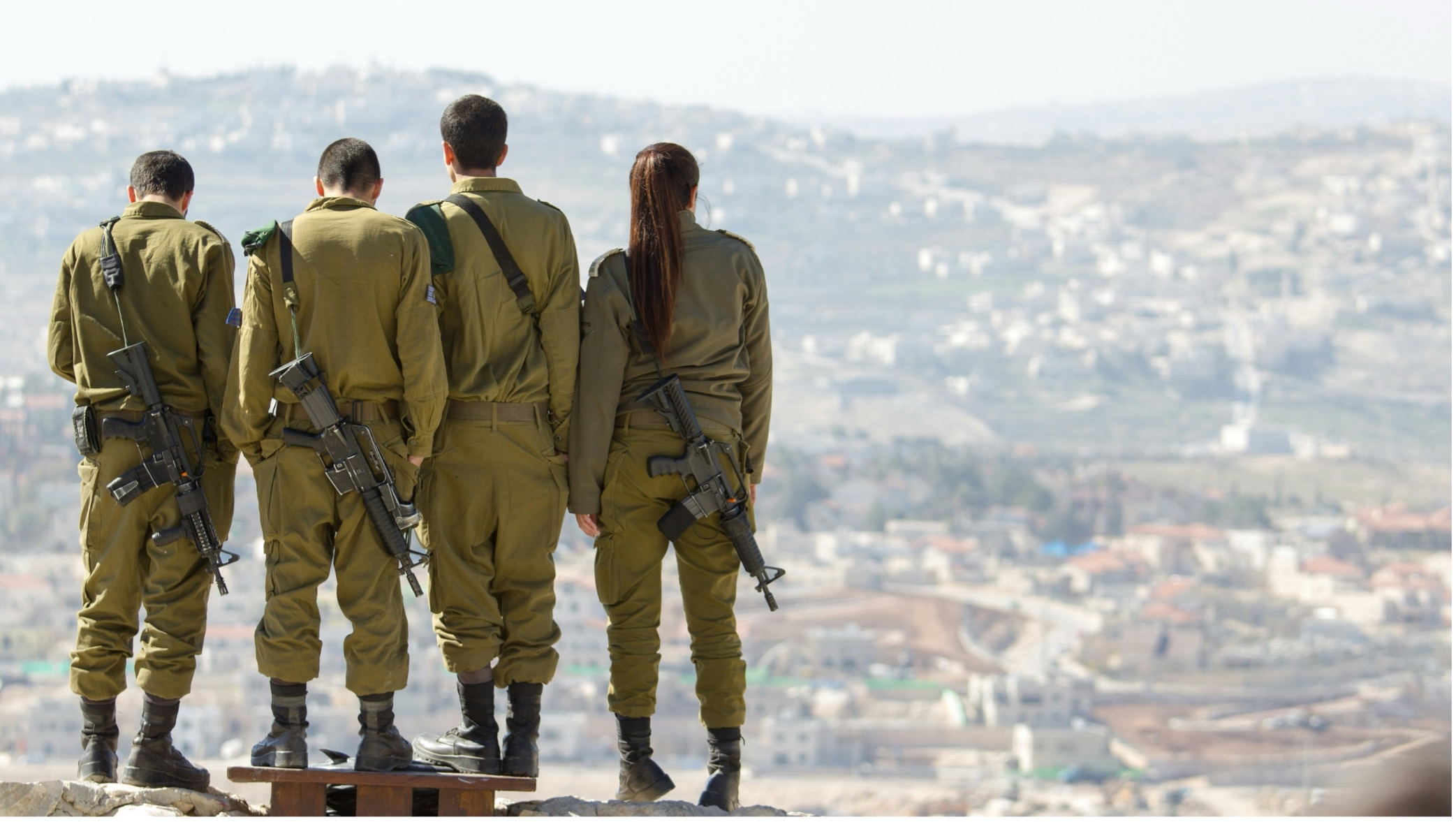
Israeli soldiers (photo: Timon Studler / Unsplash)
Back to Forum
Three Jewish Voices on War and Morality
A year ago, I discussed the terrible Israel-Hamas war in this forum and looked for religious undertones. What a tragic and sad reality that this war is still raging a year later and that the situation for the hostages, civilians, and the entire region has continued to deteriorate significantly. The reports on the war and its effects, as compiled by Israeli historian Lee Mordechai, for example, are staggering.[1] As I write these lines, the Israel Defense Forces (IDF) are preparing a large-scale ground operation in Gaza City that is expected to last several months. It is, therefore, to be feared that this war still will not be over in a year’s time.
In recent weeks, I have been studying Jewish military ethics more intensively in order to better understand the background and logic, especially on the Israeli side. Rabbi Shlomo Brody’s book Ethics Of Our Fighters, published in 2023, has been helpful in this regard.[2] Brody points out that in Judaism, reflection on war and morality—unlike in Christianity, which has been engaged in heated debates about just war theories for centuries—only gained momentum in the course of Israel’s statehood in the 20th century, even though connections can be traced back to biblical times.[3] Three prominent Jewish voices will be briefly presented here:
- Shlomo Goren (1917-1994) – the pioneer: As the first Chief Rabbi of the IDF, Goren played a decisive role in developing a modern Jewish military ethic.[4] His concern with reconciling religious principles with military necessities remains groundbreaking to this day. On the one hand, he repeatedly called for humanity in armed conflicts. On the other hand, he believed that defending the Jewish people and the State of Israel was a religious commandment (mitzvah) of the highest priority. Goren’s work already clearly reveals the religious underpinnings of national interests, which are also fueling the current war in Gaza.
- Yeshayahu Leibowitz (1903-1994) – the critic: In contrast to Goren, Leibowitz, who was considered one of Israel’s leading intellectuals during his lifetime, positioned himself as a sharp critic of the Israeli military, especially after the Six-Day War in 1967. He warned that the ongoing occupation of the territories would corrupt Israeli society and the military. Leibowitz even called for refusal to serve in the occupied territories. He believed that the military had long since ceased to be a purely defensive force and had become a tool of occupation policy. Ultimately, however, his drastic warnings against brutalization under rule over another people served to preserve the moral integrity of the state and the army. Despite or because of this radical criticism, after his death he was honored by the then Israeli President Ezer Weizmann as the “spiritual conscience” of Israel. Leibowitz thus embodies a second important strand within Jewish military ethics, which is suspicious of any form of sacralization of the military and regards the glorification of the state, country, or army as a form of religious idolatry.
- Asa Kasher (born 1940) – the reformer: Asa Kasher is the most influential contemporary architect of an explicitly formulated Israeli-Jewish military ethic. As the main author of the IDF code of ethics, The Spirit of the IDF (revised several times since the 1990s), he established fundamental values such as human dignity, the sanctity of life, responsibility, and professionalism. The code is not based exclusively on religious principles, but integrates a secular, philosophical perspective that is strongly deontological. In programmatic essays[5], Kasher also drafted a normative doctrine of asymmetric warfare – a form of warfare that is particularly relevant to the Israeli context. This doctrine includes, among other things, a strict distinction between combatants and non-combatants, advance warnings, the choice of the most sparing effective means, but also a hierarchy of duties that prioritizes first the protection of one’s own civilians, then one’s own soldiers, and then the sparing of enemy civilians. Both the Israeli and Palestinian sides have sharply criticized the latter hierarchy in particular.[6]
These three brief sketches have hopefully provided an initial insight into the lively discussions surrounding Jewish military ethics, which Brody explores in his highly readable monograph. Can they help us understand what is currently happening in the Gaza Strip? At the very least, it is clear that debates about religion and nationalism (Goren), occupation and integrity (Leibowitz), and the dilemmas of asymmetric warfare (Kasher) have preoccupied Israeli society for decades. Perhaps this also explains why the commander-in-chief of the IDF, Eyal Zamir, openly contradicts Prime Minister Benjamin Netanyahu’s war plans.
—
[1] Mordechai, L. (n.d.). Bearing Witness Gaza. Witnessing the Gaza War. Retrieved 16 August 2025, from https://witnessing-the-gaza-war.com/
[2] Brody, S. M. (2023). Ethics of Our Fighters: A Jewish View on War and Morality. Toby Press.
[3] Levin, Y., & Shapira, A. (Eds.). (2019). War and Peace in Jewish Tradition: From the Biblical World to the Present. Routledge.
[4] Edrei, A. (2005). Divine Spirit and Physical Power: Rabbi Shlomo Goren and the Military Ethic of the Israel Defense Forces. Theoretical Inquiries in Law, 7(1), 255–297. https://doi.org/10.2202/1565-3404.1124
[5] Kasher, A., & Yadlin, A. (2005). Military Ethics of Fighting Terror: An Israeli Perspective. Journal of Military Ethics, 4(1), 3–32. https://doi.org/10.1080/15027570510014642
[6] Khalidi, M. A. (2010). ‘The Most Moral Army in the World’: The New ‘Ethical Code’ of the Israeli Military and The War on Gaza.Journal of Palestine Studies, 39(3), 6–23. https://doi.org/10.1525/jps.2010.XXXIX.3.6